

Pricing the Universe’s Leftover Code
Valuing Topological Relics in the Post-Inflationary Economy

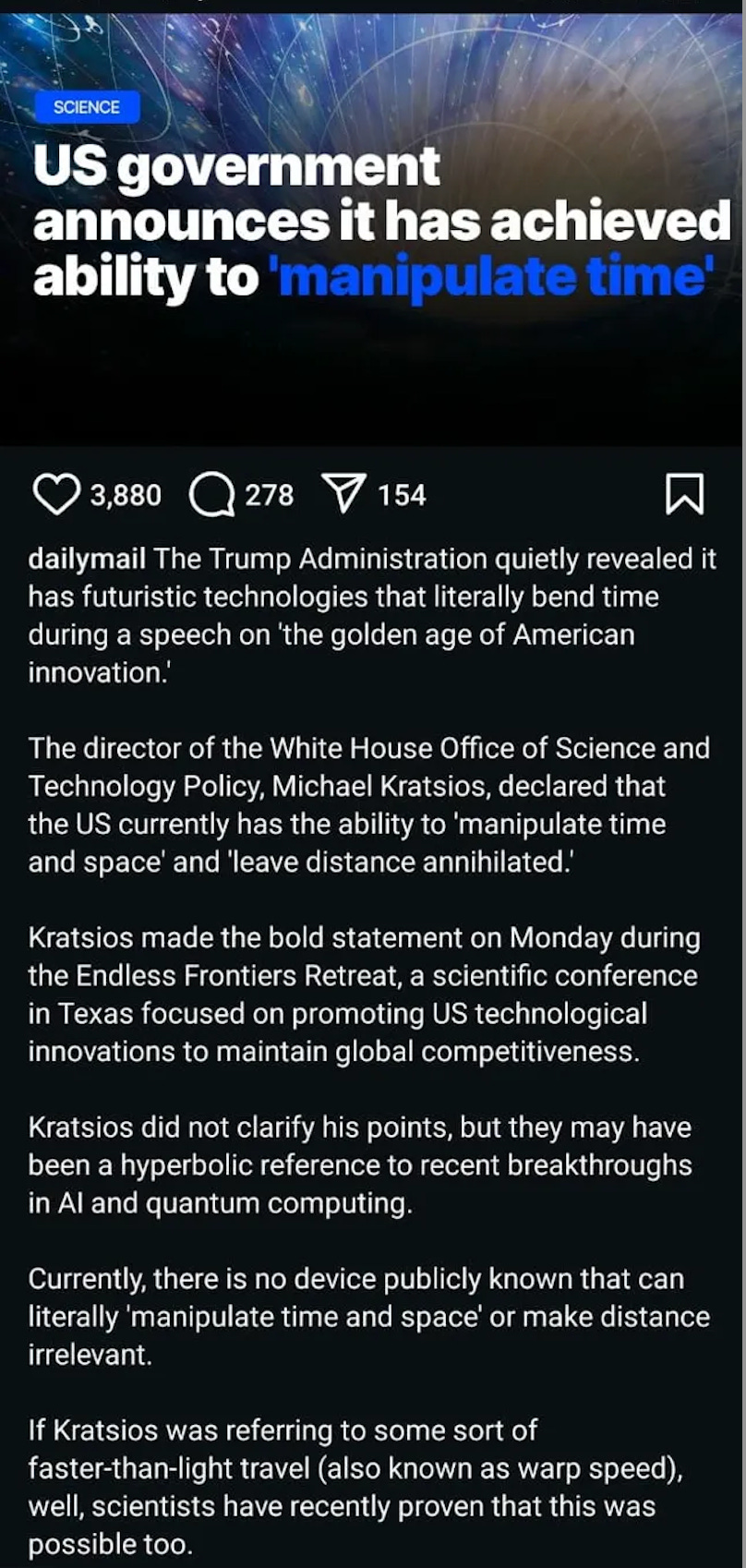
in january 2025, michael kratsios, director of the white house office of science and technology policy, a man whose job description is “don’t say the quiet part out loud,”gave a speech about american innovation at something called the endless frontiers retreat.
very aspirational name. very “we’ve run out of earth so let’s get WEIRD with physics.”
during this speech, kratsios announced that the united states has achieved the ability to “manipulate time and space” and “leave distance annihilated.”
he did not elaborate.
he did not take questions.
he simply said it into a microphone in texas, at a conference full of people who already knew what he meant, and then everyone went back to networking.
the daily mail, bless them, called it “futuristic technologies that literally bend time.” most outlets ignored it. a few assumed he meant quantum computing and got drunk on metaphor.
nobody asked why you’d use the phrase “manipulate time” at a COMPETITIVENESS conference unless you were either catastrophically imprecise with language or sending a very specific signal to a very specific list of people with very specific clearances.
and here’s the thing about that list: they’ve been busy.
there are declassified briefings floating around now, beautiful hand-drawn schematics of closed timelike curves, very nasa mission patch aesthetic, very “what if we contacted last tuesday,”with funding codes attached. not a lot of people are drawing those for fun. you don’t hire relativists with security clearances to sketch hypothetical geometries unless you’re pricing SOMETHING.
oh, and on friday, nine months after kratsios made his little announcement—someone opened a bitcoin short thirty minutes before trump surprise-announced tariffs that tanked the market.
they closed the position with $88 million in profit.
same day account. clean entry, clean exit.
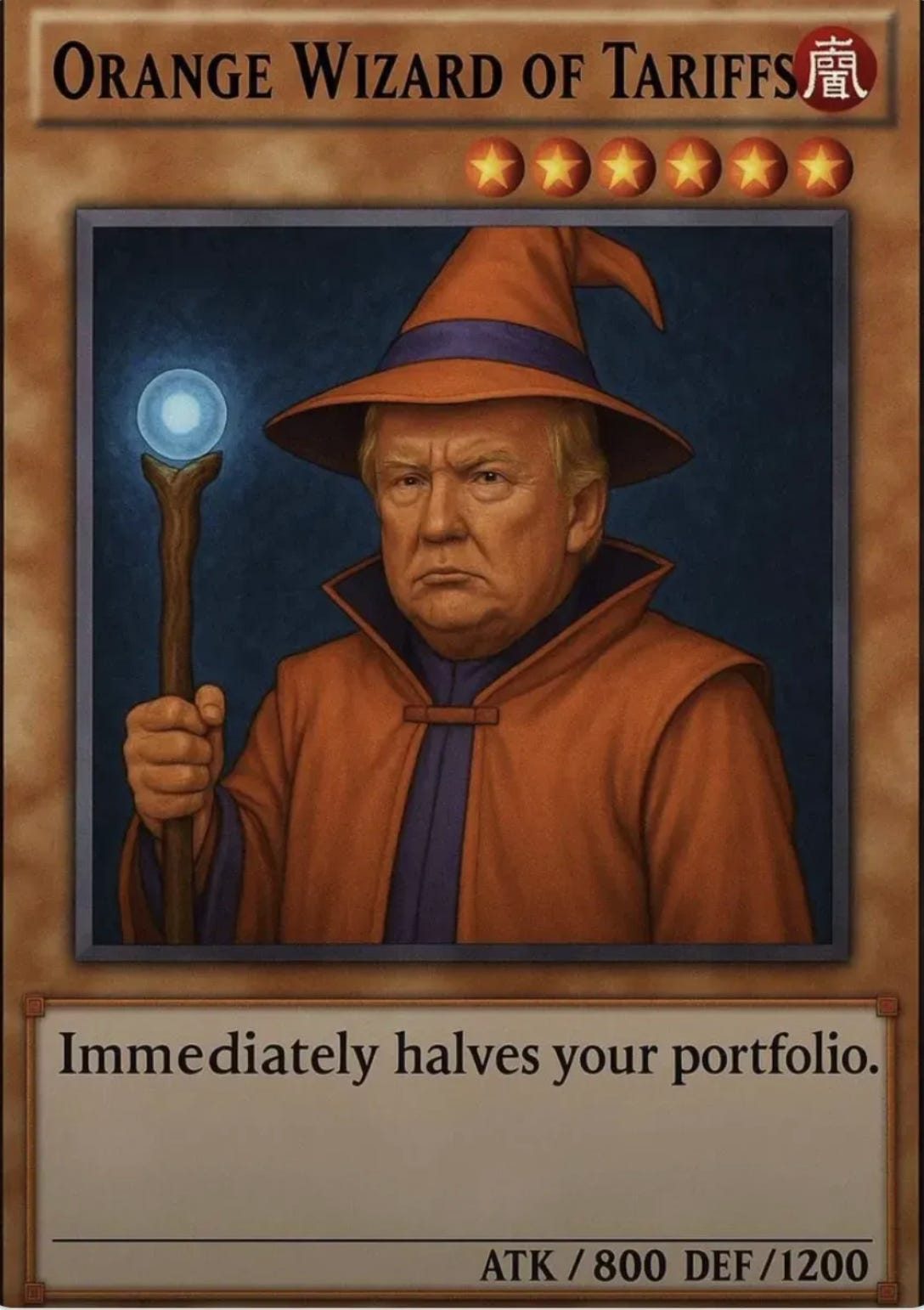
everyone’s calling it insider trading, which is the boring explanation. a more interesting question is: insider to WHAT? to a phone call? to next week’s wall street journal? to a region of spacetime with negotiable causality?
anyway. let’s talk about what you’d actually need to buy if you wanted to make that second option stop sounding insane.
picture this: the early universe, just moments after the big bang, everything’s so hot that even the laws of physics are molten.
the forces we know today—electromagnetic, weak, strong—were fused into one thing, the way ice and water and steam are all just H₂O, waiting to differentiate.
then the universe cools. symmetry breaks.
think about water freezing: different regions crystallize in different directions— here the lattice points north, there northeast. where those domains meet, you get defects— cracks where the crystal structure refuses to agree.
now scale that up to the entire universe and swap “crystal orientation” for “vacuum field configuration.”
those cracks are called cosmic strings.
what even is a cosmic string
a one-dimensional topological defect—literally a place where two incompatible versions of spacetime got stitched together wrong and the seam never healed.
not a choice, not a mistake—just what happens when certain gauge symmetries snap in 3+1 dimensions.
the math (homotopy groups, if you’re nasty) guarantees it. in higher dimensions you’d get monopoles or walls; here, in our four-dimensional block universe, you get strings.
they’re thinner than a proton but can stretch across galaxies.
and they’re tense.
tension = “this warps spacetime so hard it’s basically a cosmic trip hazard”
GUT-scale’ refers to the unimaginably high-energy conditions—around 10¹⁶ GeV—when the electromagnetic, weak, and strong forces were still unified. It’s the energy frontier where physics itself first fractured, leaving behind relics like cosmic strings.
a GUT-scale string carries a tension around
μ ≈ 10²¹ kg/m.
that’s the mass of a small continent—per meter.
the spacetime around it is so violently curved that if two ships flew opposite directions around one, they’d reunite displaced—as if a wedge of space between them had been surgically excised.
light doesn’t bend smoothly around a string—spacetime itself has a deficit angle, like a cone with a slice removed. so you might see a galaxy twice in your telescope, slightly offset, the image split by missing geometry.
it’s not matter. it’s frozen topology. mass-energy trapped in the shape of a defect.
how much string can we afford
imagine we find a closed loop about one light-second long— strings oscillate and chop off loops as they decay.
L ≈ 3 × 10⁸ m.
total mass-energy:
E = μL c² ≈ 3 × 10⁴⁶ J.
that’s thirty million years of solar output compressed into three hundred thousand kilometers of spacetime scar.
mining a single bitcoin currently burns roughly 3 × 10¹² J of energy (post-halving, with the network running at ~15-20 GW).
so our little cosmic ring would cost
(3 × 10⁴⁶ J) / (3 × 10¹² J/BTC) = 10³⁴ BTC.
cool. only twenty-seven orders of magnitude above the total supply cap.
but wait—do they even exist?
probably not nearby.
inflation—the universe’s brief bout of exponential expansion—didn’t just stretch strings; it diluted them out of existence.
if inflation lasted even a few e-folds longer than the minimum, every string was pushed beyond our cosmic horizon.
the scarcity isn’t a market mistress; it’s a cosmological fact.
if there’s one loop left in the observable universe, we’re already absurdly lucky.
so let’s be generous: apply a scarcity multiplier of 10²⁰, not for markets but for miracle.
effective value ≈ 10⁵⁴ BTC.
the part where causality becomes optional
here’s the part that never makes it into the pop-sci articles:
if two cosmic strings passed each other at near-lightspeed, under exactly the right conditions—tension, separation, velocity—the spacetime between them could theoretically support closed timelike curves.
translation: a region where causality folds back on itself. where ‘before’ and ‘after’ become negotiable.
you can’t build a cosmic string, they only form during symmetry-breaking phase transitions, maybe in the first 10⁻³⁵ seconds if they’re GUT-scale, maybe later if they’re from different breaking scales. point is: you missed your window by 13.8 billion years.
but if you could find one—and another—and hurl them past each other fast enough…
you’re not buying energy. you’re buying a fixed point in the topology of spacetime itself.
the only thing more expensive than the string? the machine that finds it. or the one that makes you able to use it!
conclusion
a cosmic string isn’t a commodity. it’s a scar from when the universe was learning how to be.
the frozen boundary between two vacuum states that couldn’t coexist.
if you could hold one, assuming your atoms didn’t shear apart from tidal forces, you’d be holding the memory of unification giving way to diversity.
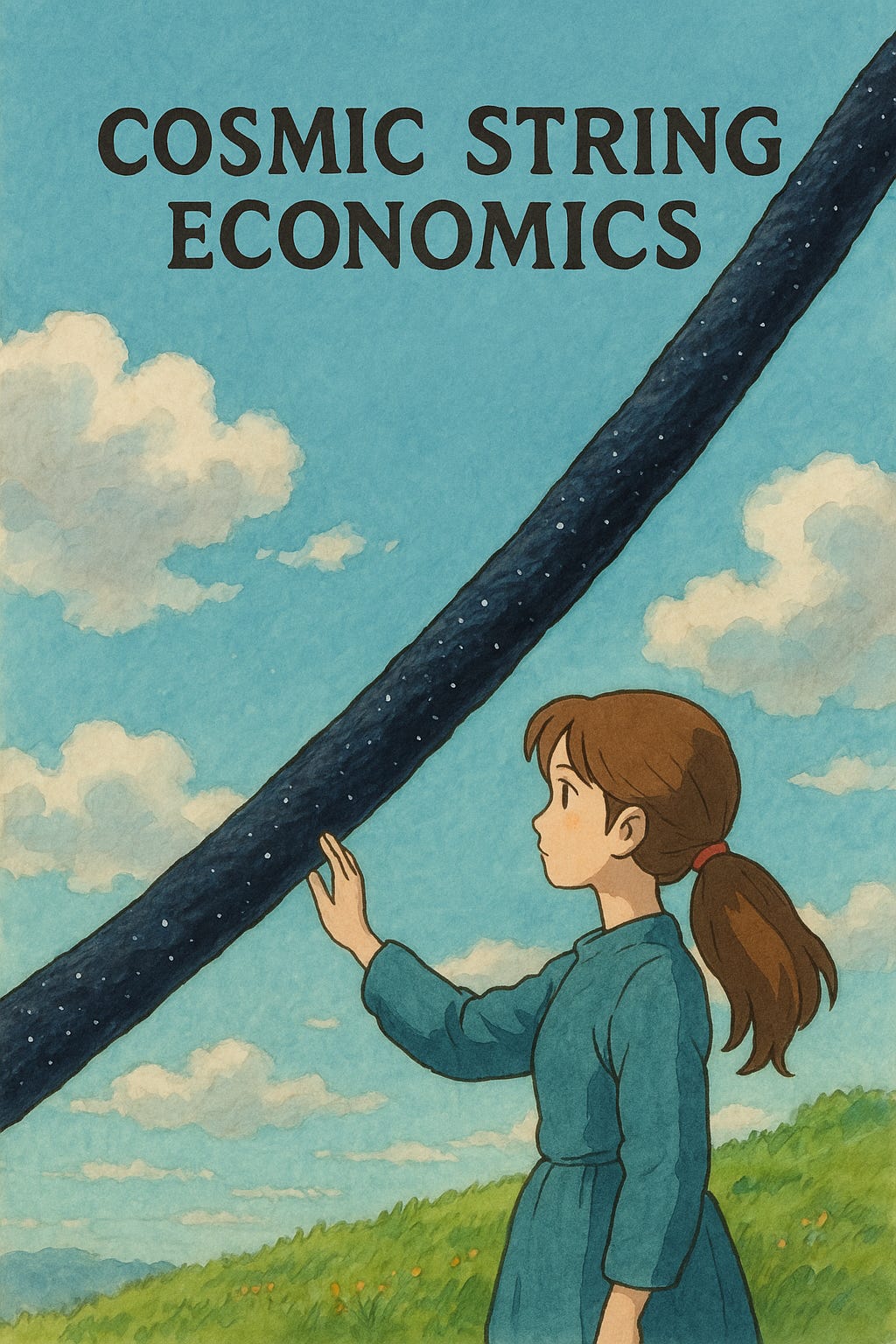
in BTC: ~10⁵⁴ in truth: priceless.
because you’re not buying a thing, you’re buying the geometry of everything that ever happened after symmetry broke.
and maybe, if you’re clever and a little amoral, the geometry of everything that could.